
Across the Middle East, sustainability has become a common word in the design and development industry. It appears in project briefs, masterplans, and strategy documents. But an important question remains:
Are we truly designing sustainable environments, or are we simply applying sustainability labels to conventional solutions?
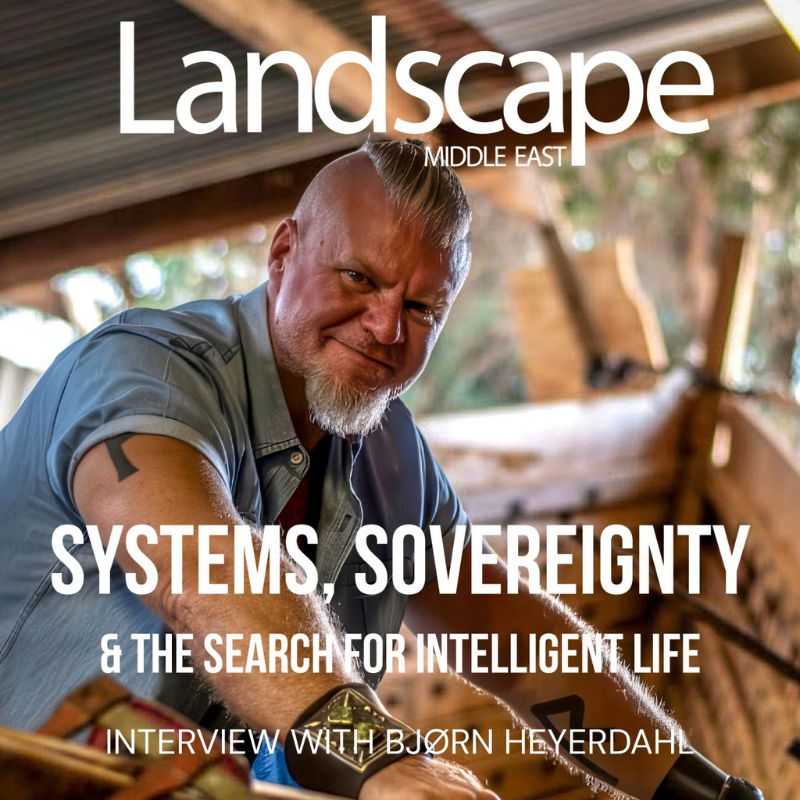
In the March issue of Landscape Middle East Magazine, Bjørn Heyerdahl, Sustainability Lead at Desert Group, invites the industry to pause and reflect on that question.
In a thoughtful and wide-ranging conversation, he challenges designers, engineers, and decision-makers to reconsider how sustainability is understood and implemented in real-world projects.
Rather than focusing on checklists or certifications, the discussion explores sustainability through a deeper lens — systems thinking — and what it means for the future of landscape design and urban environments in the region.
Landscapes as Living Systems in Sustainable Design
One of the central themes of the interview is the idea that landscapes should not be treated merely as decorative features in urban environments.
When designed thoughtfully, landscapes function as living ecological systems.
They regulate water flow, support biodiversity, stabilize soils, and influence microclimates within cities. At the same time, they create spaces where communities gather, interact, and experience their surroundings.
In many ways, landscapes quietly perform functions that cities often rely on complex infrastructure to manage.
This perspective encourages a shift in how sustainable landscape design is approached. Instead of treating nature as something that must be controlled or managed, landscapes can become active infrastructure supporting environmental resilience.
At Desert Group, this philosophy shapes many of the landscape projects delivered across the UAE and the wider region.
Explore more about our approach to landscape architecture and sustainable design here
Systems Thinking in Landscape Architecture
Another theme explored in the conversation is the importance of systems thinking in shaping sustainable environments.
Instead of focusing on individual project components, systems thinking asks a broader set of questions.
How do water systems interact with landscapes?
How do ecological processes influence urban environments?
How can design decisions made today support resilience decades into the future?
By understanding these relationships, designers and planners can begin to create landscapes that function as integrated systems rather than isolated design elements.
This shift in perspective is becoming increasingly important as cities across the region continue to grow and evolve.
Water Management and Landscape Infrastructure in the Gulf
Water management is one of the most pressing environmental challenges across the Gulf region.
Cities across the UAE face a combination of intense rainfall events, rising groundwater levels, and rapid urban expansion. Traditional solutions often rely on engineered infrastructure designed to move water away from urban environments as quickly as possible.
However, landscapes themselves can play a critical role in managing water systems.
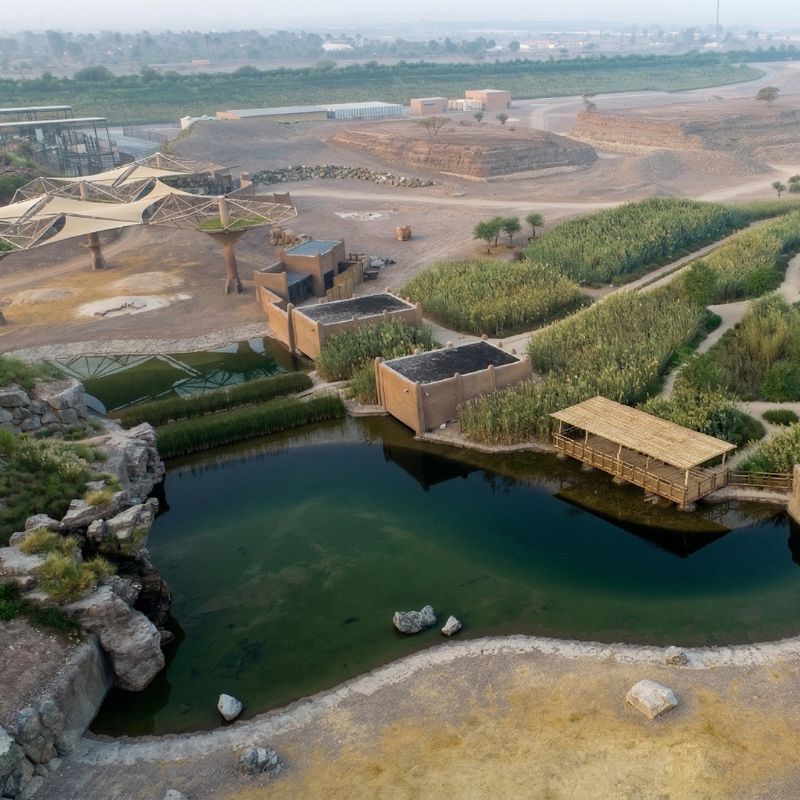
Through permeable surfaces, vegetated corridors, retention basins, and ecological planting strategies, landscapes can help regulate water movement naturally.
These nature-based solutions not only reduce pressure on mechanical systems but also improve environmental health and urban resilience.
For rapidly growing cities, sustainable landscape design offers an opportunity to address environmental challenges while enhancing the experience of public space.
Learn more about how Desert Group integrates sustainability into landscape projects
The Future of Sustainable Landscape Design in the Middle East
The conversation also reflects a broader shift happening across the design industry.
Sustainability is no longer discussed only in theory. Increasingly, it is being tested and implemented in real landscapes and urban environments.
This shift requires collaboration between landscape architects, engineers, urban planners, ecologists, and policy makers.
It also requires a willingness to rethink conventional development approaches.
Resilient cities depend not only on architecture and infrastructure but also on the landscapes that support them.
At Desert Group, this perspective continues to shape how landscapes are designed, delivered, and maintained across the region
Continuing the Sustainability Conversation
The feature in Landscape Middle East Magazine explores these ideas in greater depth and highlights how systems thinking can influence sustainable design practices across the region.
For professionals working in architecture, landscape design, and urban planning, the conversation serves as both an invitation and a challenge to rethink how sustainability is implemented in practice.
As development across the Middle East continues at an extraordinary pace, these discussions play an important role in shaping the next generation of resilient landscapes and urban environments.
The full interview with Bjørn Heyerdahl can be read in the March issue of Landscape Middle East Magazine.