Dubai Government Initiative
Dubai-It: What the City's Radical New Philosophy Means for the Landscape of the Gulf
Earlier this year, the Dubai government launched something that stopped a lot of people in their tracks. Not a new tower. Not a record. A philosophy. Two words: Dubai-It. On the surface, it sounds like a marketing line. But spend any time in this city, watching what gets built, at what pace, in what conditions and you realise it is something more honest than that. It is a description of how Dubai has always operated. The city does not wait for conditions to be right. It does not defer to precedent. It looks at an empty stretch of desert or a patch of coastline and asks: what could this be? Then it builds the answer.
Desert Group has been part of that answer since 1988. Before Dubai It had a name, it had a practice. And that practice of transforming bare, hostile terrain into living, functioning, world-class landscapes is precisely what "Dubai It" describes.
What 'Dubai-It' Actually Means
The Dubai-It philosophy, as articulated by the city's leadership, is built around a simple but radical premise: Dubai does not aspire. It delivers. The city has consistently taken on challenges that most urban environments would consider impossible like building a ski slope in a desert mall, constructing artificial island chains visible from space, making a city bloom in a place where almost nothing naturally grows and turned them into reality at a pace that still surprises observers who have been watching for decades.
But Dubai It is not about spectacle for its own sake. The philosophy, as it has been framed, is about a civic and institutional mindset: the belief that action beats deliberation, that ambition without execution is meaningless, and that the best response to a challenge is to solve it — visibly, permanently, and at scale. It is, in other words, an attitude toward transformation.
For anyone who has worked on landscape and infrastructure projects in this city, that is not a new idea. It is the founding assumption of every brief Desert Group has ever received. The question has never been "is this possible in the desert?" It has always been "how do we make it work here, at this scale, by this date?"
The Proof is in the Ground
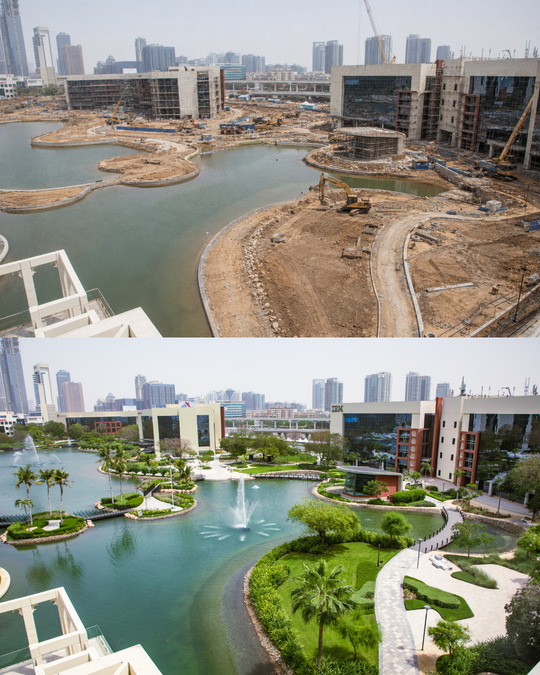
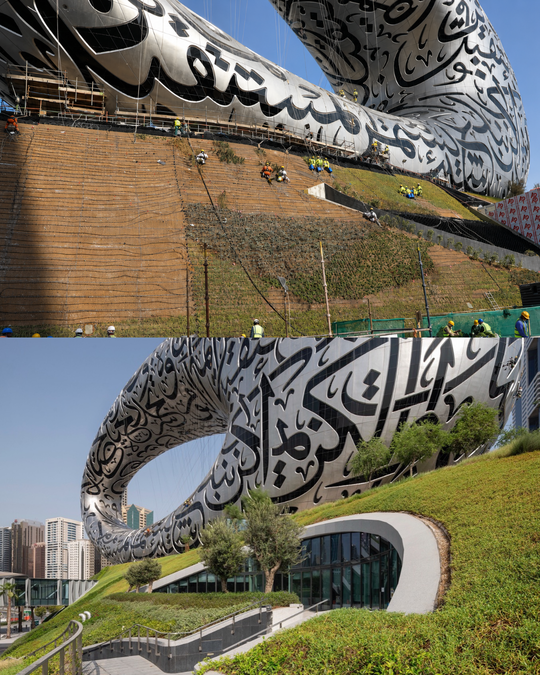
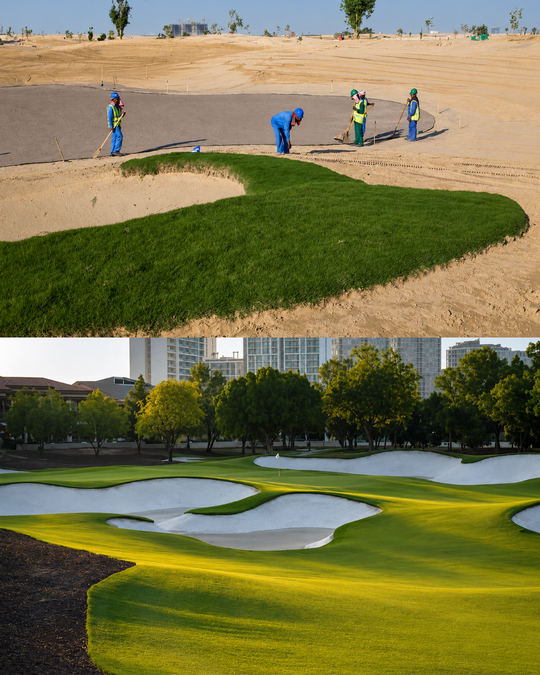
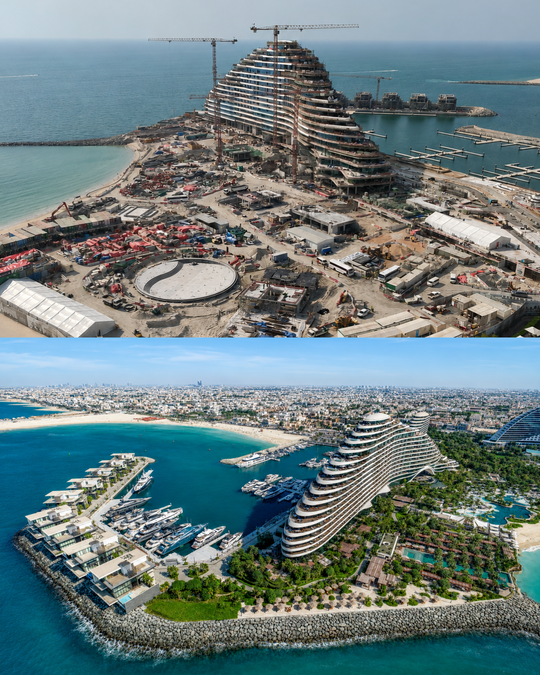
Abstract philosophies are easy to articulate. What makes Dubai It meaningful is that Dubai has done the work to back it up. And the work is visible in the skyline, in the coastline, and in the landscapes that connect them. The images below are not renders or proposals. They are Desert Group projects. Each pair shows the same site at two points in time: before, and after. The gap between those two images is what "Dubai It" looks like on the ground.
These are not four isolated moments. They are representative of more than 2,500 projects Desert Group has delivered across the UAE over 35+ years. Every one of them started with a site that looked like the "before." Every one of them ended with something that looked like the "after." That is not luck. It is capability, deployed consistently, in one of the world's most demanding environments.
What "Dubai-It" Means for Landscape Specifically
Landscape is one of the most visible expressions of the Dubai It philosophy — and one of the hardest to pull off. A tower can be designed anywhere and built to the same principles in any city. A landscape cannot. It is specific to this soil, this temperature, this rainfall, this ecosystem. Getting it right in Dubai demands expertise that does not transfer from greener climates. The Dubai It mindset applied to landscape means several things in practice:
It means building green where nothing was growing. The golf courses, resort gardens, community parks, and boulevard plantings that define the look of modern Dubai are the result of deliberate horticultural and engineering effort — soil conditioning, precision irrigation, species selection, and years of maintenance — not of favourable conditions.
It means delivering at a scale that matches the city's ambition. Dubai Hills. Yas Acres. Blue Waters. Atlantis. The Museum of the Future. These are not small gardens. They are landscape projects at the scale of city-making. The firms that deliver them need the same breadth of capability as the projects themselves demand.
It means thinking beyond the finish line. A landscape that looks good on opening day and deteriorates within two years is not Dubai It. It is a failed project. The philosophy demands that what gets built also endures, which is why maintenance, turf management, irrigation monitoring, and ecological management are as central to Desert Group's offering as design and construction.
The Next Frontier: Ecological Landscaping
Dubai It is not static. The city's ambition has always evolved — from the first towers, to the artificial islands, to the cultural institutions, to net zero commitments and green urban infrastructure. The next chapter of "doing it" in Dubai is ecological: building landscapes that do not just look alive, but function as living systems.
Constructed wetlands that treat water naturally. Swale networks that manage stormwater without concrete infrastructure. Native planting schemes that support biodiversity and reduce irrigation dependency. Green walls that cool buildings and improve air quality. These are not concepts. They are services Desert Group delivers today — through its ecological infrastructure capability, its UAE's largest nursery at Wahat Al Sahraa, its indoor landscaping division Plantscapes, and the ecological design expertise at desert INK. For developers, government clients, and masterplanners operating in Dubai right now, the sustainability agenda is no longer optional.
Estidama ratings, Net Zero 2050 commitments, and ESG requirements from investors mean that ecological performance is increasingly a delivery requirement, not a marketing aspiration. Dubai It, in other words, now applies to sustainability. And the same question applies: who actually delivers it, at scale, in this climate?